Lucee Anders
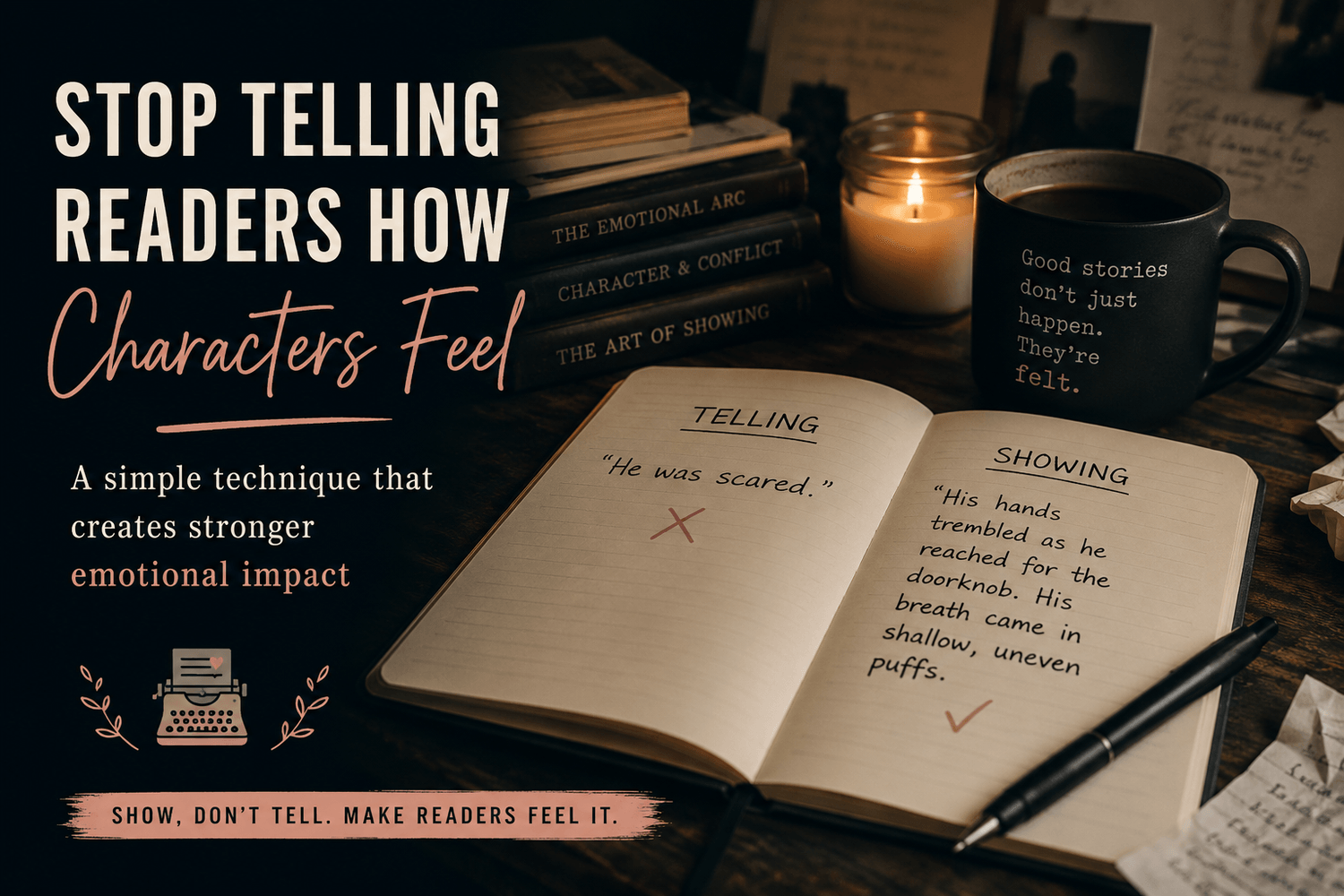
Stop Telling Readers How Characters Feel: A Simple Technique That Creates Stronger Emotional Impact
By Lucee Anders
One of the most common pieces of writing advice you'll ever hear is this:
Show, don't tell.
It's repeated in writing books, workshops, blogs, and critique groups so often that it has almost become a cliché. The problem is that while most writers have heard the advice, many aren't entirely sure what it means in practice. As a result, they either ignore it altogether or overcomplicate it.
When writers hear "show, don't tell," they often imagine they need pages of description, elaborate metaphors, or dramatic scenes filled with emotional speeches. In reality, showing emotion is much simpler than that. It's about helping readers experience emotions instead of merely being informed that those emotions exist. If you've ever wondered why some stories feel emotionally flat while others stay with you for years, the answer often lies in how emotions are presented on the page.
Let's explore how to stop telling readers what characters feel and start creating emotional experiences readers won't forget.
The Difference Between Information and Experience
At its core, storytelling is about creating experiences. Imagine someone tells you:
"The roller coaster was terrifying."
You understand the statement. You now possess information.
But compare that to:
"The safety bar rattled as the carriage climbed higher. Below, the parking lot shrank into a patchwork of tiny cars. Her stomach tightened. Then the track disappeared beneath the front wheels."
Now you're experiencing something. That's the difference between information and immersion.
When you tell readers that a character is scared, angry, heartbroken, or excited, you're giving them information. When you show readers the physical reactions, actions, thoughts, and behaviours that accompany those emotions, you're creating an experience. Readers don't remember information nearly as well as they remember experiences.
Why Writers Fall Into the Telling Trap
Telling emotions isn't a sign of poor writing. In fact, it's the natural first step in drafting. When you're focused on getting a story onto the page, it's faster to write: "James was nervous," than to stop and explore how that nervousness might manifest.
Many writers also worry that readers won't understand the emotion unless it's explicitly stated. Ironically, the opposite is often true. Readers are remarkably skilled at interpreting emotional clues. We do it every day in real life. We recognise anxiety from fidgeting, sadness from silence, frustration from clipped responses, and excitement from restless energy. Because readers already possess these skills, fiction becomes more engaging when writers trust them to make those interpretations.
What Showing Emotion Actually Looks Like
Showing emotion means revealing feelings indirectly. Rather than naming the emotion itself, you present evidence that allows readers to conclude on their own.
Let's look at a simple example.
Telling
Lena was nervous about the presentation.
Showing
Lena adjusted the stack of note cards again. Three times she opened her presentation slides just to make sure they were still there.
Notice that the word "nervous" never appears. Yet, most readers immediately understand what Lena is feeling. The emotional meaning remains intact, but the reader becomes part of the discovery process.
The Moment This Clicked for Me
While working on my current novel, I caught myself falling into the very trap I'm talking about. One of my characters transforms into a monster. In an early draft, I had written something along the lines of:
"He was terrified of what was about to happen."
The sentence communicated the information, but it didn't create an emotional experience. When I stepped back and thought about what the transformation would actually feel like, the scene changed completely. Instead of naming the fear, I focused on what the character was experiencing physically and emotionally in that moment:
"The familiar pressure gathered beneath his skin. His fingers curled involuntarily, nails biting into his palms. He stumbled backwards and caught himself against the wall. The plaster cracked beneath his grip."
Suddenly, the fear became tangible. The reader wasn't simply being told that he was afraid, but they were experiencing the loss of control alongside him, and that revision taught me something important: readers don't need emotional labels nearly as often as we think they do.
The Power of Physical Reactions
One of the easiest ways to show emotion is through physical responses. Our emotions affect our bodies constantly.
Fear causes trembling.
Anger creates tension.
Embarrassment brings heat to the face.
Excitement increases energy.
These reactions provide excellent material for writers.
Example: Fear
Telling:
Marcus was afraid.
Showing:
Marcus tightened his grip on the flashlight. The beam shook slightly as it swept across the empty hallway.
Example: Anger
Telling:
Olivia was furious.
Showing:
Olivia set the mug down carefully. Too carefully. A thin crack appeared along the handle.
Physical reactions work because they're immediate and universally understood. Readers may never have met your character, but they understand what trembling hands or clenched jaws mean.
Using Actions to Reveal Emotion
People communicate emotions through behaviour. Sometimes actions reveal emotions more effectively than descriptions ever could.
Grief
Instead of:
"He missed his father."
Try:
"He still reached for the phone every Sunday before remembering there would be no answer."
Anxiety
Instead of:
"She was worried."
Try:
"She refreshed her inbox every few minutes, even though she knew the reply wouldn't come any faster."
Joy
Instead of:
"He was happy."
Try:
"He caught himself smiling at strangers all the way home."
Actions create emotional depth because they show how feelings influence behaviour. Readers don't learn about the emotion; they see its consequences.
Dialogue as an Emotional Tool
People rarely state exactly how they feel. In fact, the stronger an emotion becomes, the less likely people are to express it directly. Think about the last time someone said, "I'm fine."
The words may have suggested one thing, while their tone suggested something completely different. Writers can use this disconnect to create powerful emotional moments.
Example
Telling:
Claire was upset about the argument.
Showing:
"It's not important," Claire said.
"It sounded important."
She shrugged and looked away.
"Can we just drop it?"
The dialogue reveals the emotion without naming it. Readers become active participants, interpreting clues and drawing conclusions.
Let the Setting Reflect Emotion
Characters don't experience the world objectively. Their emotions shape what they notice, like a hopeful character may notice sunlight, a grieving character may notice silence, or an anxious character may notice every unusual sound.
For example:
"The waiting room smelled faintly of disinfectant. Every tick of the clock sounded louder than the last."
The description tells us something about the character's emotional state without explicitly stating it. This technique creates atmosphere while simultaneously deepening characterisation.
Common Mistakes When Showing Emotion
While learning to show emotions, writers often make a few mistakes.
Mistake #1: Overdoing Body Language
A character can't shrug, sigh, smile, nod, clench their jaw, and cross their arms in every scene. Too many physical reactions become repetitive. So, choose the details that matter most. One strong emotional clue is more effective than five weak ones.
Mistake #2: Explaining the Emotion Afterwards
Consider this example:
"His hands trembled as he opened the envelope. He was terrified of what it might contain."
The first sentence already shows fear; the second sentence explains what readers have already understood. Trust the reader. Once you've shown the emotion effectively, resist the urge to immediately explain it.
Mistake #3: Showing Everything
This may surprise you, but not every emotion deserves a detailed scene. Sometimes efficiency matters. If a character feels mildly annoyed because they forgot their umbrella, a simple statement may be perfectly adequate. Reserve your strongest emotional showing for moments that matter most.
When Telling Is the Better Choice
Many writers treat "show, don't tell" as an absolute rule, and it isn't. Great writing balances both.
Telling is useful when:
You need to move quickly through less important moments.
The emotional detail isn't central to the scene.
You need to summarise events efficiently.
Excessive showing would slow pacing.
The goal isn't to eliminate telling, but to use showing strategically where emotional impact matters most.
A Practical Revision Exercise
Try this exercise with your own writing.
Search your manuscript for emotional labels such as:
Angry
Nervous
Happy
Sad
Frustrated
Embarrassed
Afraid
Excited
Lonely
Heartbroken
For each one, ask yourself:
Can readers infer this emotion from something more concrete?
Could you reveal it through:
An action?
A physical reaction?
A line of dialogue?
A thought?
A sensory detail?
You don't need to replace every emotional label. Even improving a handful of key emotional scenes can dramatically strengthen a manuscript.
Why This Technique Matters
Stories are emotional experiences, and readers don't stay up late turning pages because they want information. They stay up late because they care about characters, the outcomes, and because the story makes them feel something. When writers rely too heavily on emotional labels, they create distance between readers and characters. When writers show emotions through actions, dialogue, reactions, and sensory details, they close that distance.
When readers step inside the story, they stop observing from afar and begin experiencing events alongside the characters. And that is where emotional connection is born.
Final Thoughts
The next time you're revising a scene, pay attention to every place you've named an emotion.
Instead of writing:
"She was devastated."
Ask yourself:
What would devastation look like?
Would it be the unanswered text message she keeps rereading?
The untouched coffee growing cold beside her?
The way she automatically reaches for a phone call she can no longer make?
Emotion becomes powerful when readers discover it for themselves. Your job as a writer isn't to tell readers what to feel, but to create the conditions that allow them to feel it. When you learn to do that consistently, your writing becomes more immersive, more memorable, and far more emotionally resonant. And that's when readers stop reading your story and start living it.
Stop Telling Readers How Characters Feel: A Simple Technique That Creates Stronger Emotional Impact
© 2024 Lucee Anders. All rights reserved.